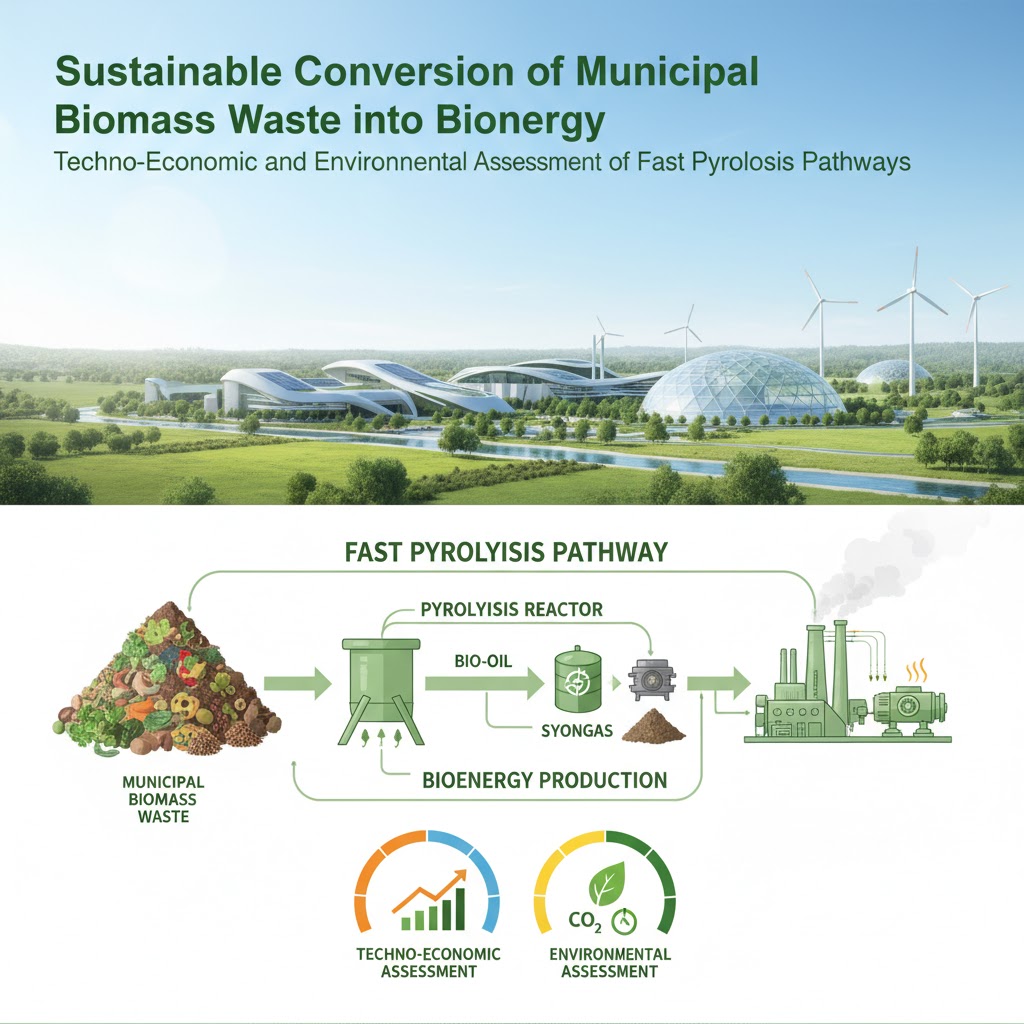
Sustainable Conversion of Municipal Biomass Waste into Bioenergy: Techno-Economic and Environmental Assessment of Fast Pyrolysis Pathways
Keywords:
Fast pyrolysis, Municipal biomass waste, Bio-oil production, Techno-economic assessment, TEA, Life cycle assessment (LCA), Renewable energy, Circular bioeconomyAbstract
Municipal biomass waste offers a promising feedstock for renewable energy production, yet its techno-economic and environmental potential remains underexplored. This study investigates the feasibility of producing bio-oil through fast pyrolysis using integrated process simulation, techno-economic assessment (TEA), and life cycle assessment (LCA). Simulation results showed that pyrolysis at 500–550 °C yielded up to 60 wt.% bio-oil, outperforming biochar and gas fractions. TEA indicated strong economies of scale, with the minimum fuel selling price (MFSP) decreasing from USD 1.28/L at 50 t/day to USD 0.71/L at 500 t/day, approaching parity with fossil fuels. LCA further demonstrated that optimized pathways with energy integration reduced the global warming potential to 21 g CO₂-eq/MJ, substantially lower than fossil diesel at 94 g CO₂-eq/MJ. These findings confirm that fast pyrolysis of municipal biomass waste is not only technically feasible but also economically competitive and environmentally advantageous, positioning it as a strategic solution for urban waste valorization and sustainable energy transitions.
Downloads