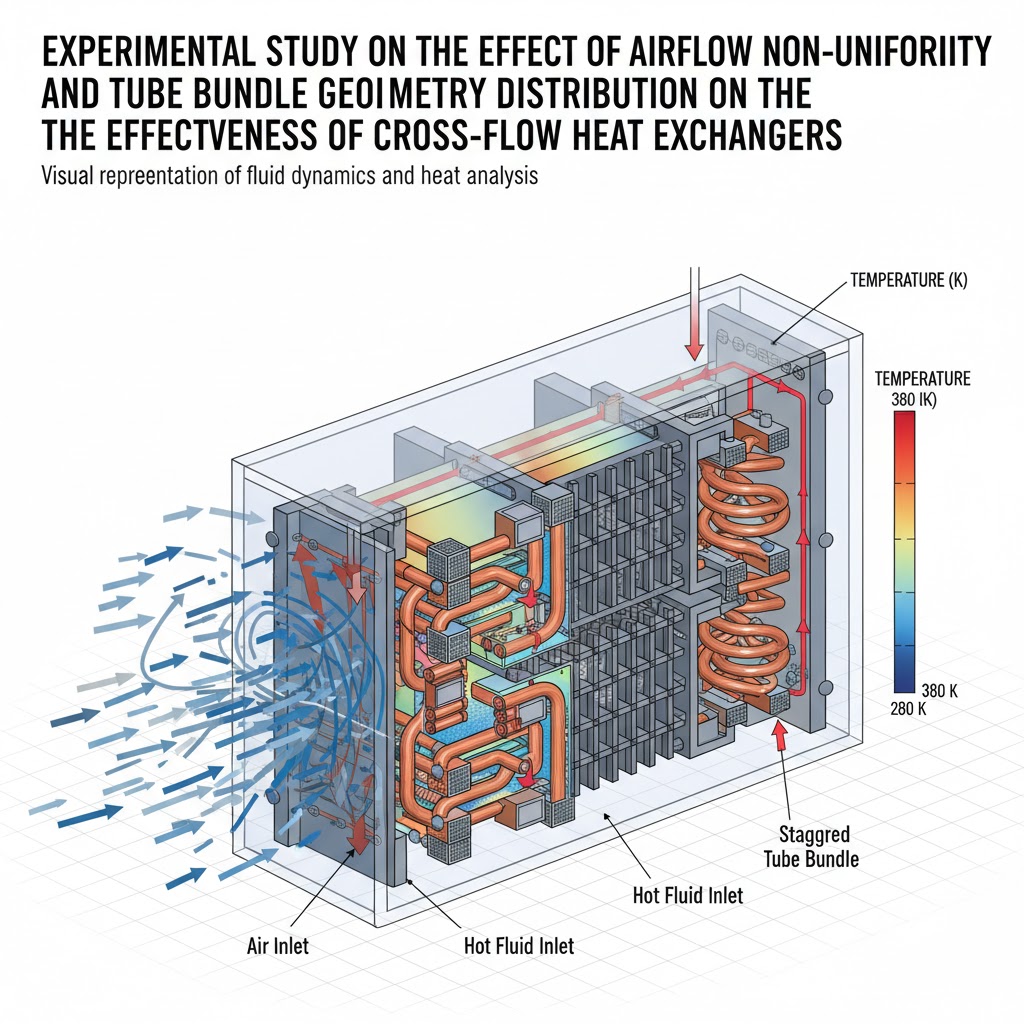
Experimental Study on the Effect of Airflow Non-Uniformity and Tube Bundle Geometry Distribution on the Effectiveness of Cross-Flow Heat Exchangers
Keywords:
Cross-flow heat exchanger, Airflow non-uniformity, Tube bundle geometry, Heat transfer effectiveness, Thermal–hydraulic performance, Experimental study, Geothermal energyAbstract
This study investigates the impact of airflow non-uniformity and tube bundle geometry distribution on the thermal performance of a cross-flow heat exchanger, a crucial component in energy and HVAC systems where efficiency strongly depends on uniform heat transfer conditions. An experimental setup was developed to evaluate airflow uniformity levels of 100%, 85%, and 70% combined with two geometric configurations—inline and staggered—under a controlled mean air velocity of 3 m/s. Measurements of temperature distribution, airflow velocity, and pressure drop were used to calculate the thermal effectiveness (ε), Nusselt number (Nu), and thermal–hydraulic performance index (ηₜₚ). The results revealed that decreasing airflow uniformity caused a 12–18% reduction in effectiveness, while the staggered configuration achieved up to 23% higher heat transfer coefficients and maintained ηₜₚ > 1.1, indicating superior overall performance despite increased pressure loss. The combined effect of non-uniform airflow and geometric variation exhibited a nonlinear interaction, emphasizing the necessity for integrated optimization of flow distribution and geometry. Overall, the findings demonstrate that geometric optimization, particularly the use of staggered tube arrangements, can effectively mitigate the negative effects of airflow maldistribution and enhance the energy efficiency and resilience of air-cooled cross-flow heat exchangers.
Downloads