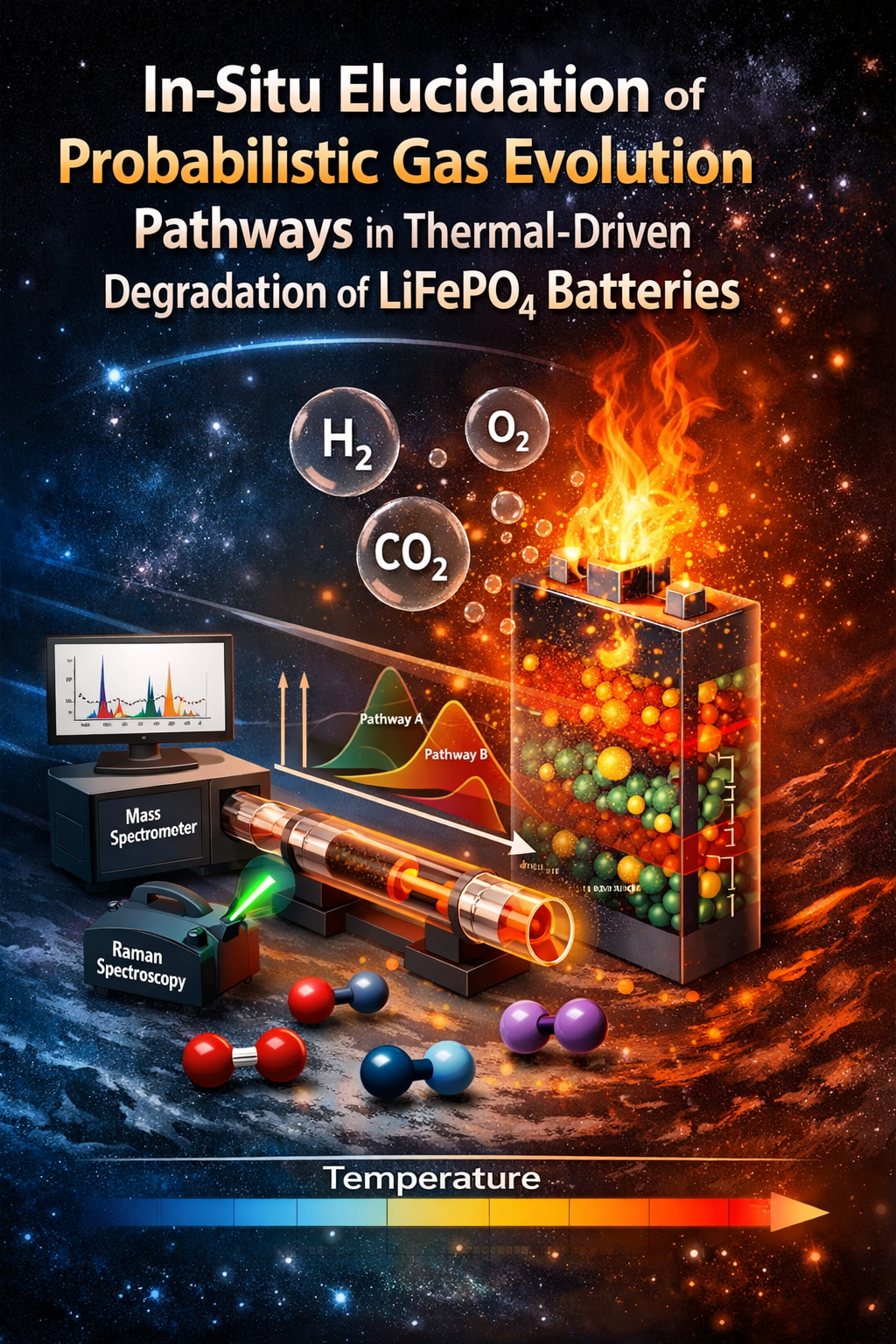
In-Situ Elucidation of Probabilistic Gas Evolution Pathways in Thermal-Driven Degradation of LiFePO₄ Batteries
DOI:
https://doi.org/10.17524/ijesmi.v1i2.12Keywords:
LiFePO₄, thermal runaway, gas evolution, electrolyte decomposition, battery safetyAbstract
Lithium-ion batteries are increasingly utilized to meet modern energy storage demands for high performance and sustainability. Despite their strong thermal stability, lithium iron phosphate (LiFePO₄) batteries face safety challenges from flammable gas emissions during thermal runaway. This study systematically examines gas evolution pathways through in-situ analysis and structural characterization of the LiFePO₄ cathode, identifying six key reactions driving thermal degradation. Results show that ethylene and carbon dioxide are the main gases produced, primarily from electrolyte decomposition. Diethyl carbonate undergoes evaporation and degradation, while ethylene carbonate reacts with active electrode materials. Although cathode structural changes occur under heat, no direct oxygen release was observed. The main causes of thermal runaway are anode–electrolyte reactions generating heat and gases between 200–300°C. Correlation analysis further indicates that hydrogen formation results from interactions between metallic lithium and trace water in a reductive environment. These findings enhance understanding of degradation chemistry and support the design of next-generation LiFePO₄ batteries with improved thermal safety.
Downloads
References
[1] T. Sun, L. Wang, D. Ren et al., “Thermal Runaway Characteristics and Modeling of LiFePO₄ Power Battery for Electric Vehicles,” Automotive Innovation, vol. 6, pp. 414–424, Aug. 2023. SpringerLink+1
[2] H. Shen, H. Wang, M. Li et al., “Thermal Runaway Characteristics and Gas Composition Analysis of Lithium-Ion Batteries with Different LFP and NCM Cathode Materials under Inert Atmosphere,” Electronics, vol. 12, no. 7, 1603, Mar. 2023. MDPI
[3] M. Zhang, Y. Cao, X. Zhang et al., “Study on Thermal Runaway Propagation Characteristics of Lithium Iron Phosphate Battery Pack under Different SOCs,” Electronics, vol. 12, no. 1, 200, Jan. 2023. MDPI
[4] F. Jin, W. Zhao, J. Zhang et al., “High-Temperature Stability of LiFePO₄/Carbon Lithium-Ion Batteries: Challenges and Strategies,” Sustainable Chemistry, vol. 6, no. 1, 7, Feb. 2025. MDPI
[5] X. Zhang, P. Sun, S. Wang, Y. Zhu, “Experimental Study of the Degradation Characteristics of LiFePO₄ and LiNi₀.₅Co₀.₂Mn₀.₃O₂ Batteries during Overcharging at Low Temperatures,” Energies, vol. 16, no. 6, 2786, Mar. 2023. MDPI
[6] P. Zhuo, Y. Chen et al., “Comparative analysis of heat and gas production characteristics during thermal runaway of semisolid and liquid electrolyte lithium-ion batteries,” Energy Storage Science and Technology, 2025. esst.cip.com.cn
[7] T. Sun et al., “Thermal Runaway Characteristics and Modeling of LiFePO₄ Power Battery for Electric Vehicles,” Automotive Innovation, vol. 6, 414-424, 2023. Ouci
[8] H. Shen et al., “Gas Composition Analysis … under Inert Atmosphere,” Electronics, vol. 12, 1603, 2023. Ouci
[9] “Why LiFePO₄ Thermal Runaway: Causes, Hazards, Solutions | LiFePO4 Battery,” online resource, 2025. lifepo4-battery.com
[10] U.S. Dept. of Energy report, “Oxygen Release Degradation in Li-ion Battery Cathode,” exploring oxygen evolution phenomena, 2022. OSTI
[11] D. Vernardou, “Recent Report on the Hydrothermal Growth of LiFePO₄ as a Cathode Material,” Coatings, vol. 12, no. 10, 1543, Oct. 2022. MDPI
[12] J. Gao, M. Fan, C. Wang, W. Liu, Y. Zhu, “Study on Temperature Change of LiFePO₄/C Battery Thermal Runaway under Overcharge Condition,” IOP Conf. Ser. Earth Environ. Sci., vol. 631, 2021. Beijing Institute of Technology
[13] “Experimental Research on Thermal-Venting Characteristics of the Failure 280 Ah LiFePO₄ Battery: Atmospheric Pressure Impacts and Safety Assessment,” Energies, 2024. MDPI
[14] Y. Yao, P. Harabin, M. Behandish, I. Battiato, “Non-intrusive Hybrid Scheme for Multiscale Heat Transfer: Thermal Runaway in a Battery Pack,” arXiv, 2023. arXiv
[15] J. Lin, H.N. Chu, C.W. Monroe, D.A. Howey, “Anisotropic Thermal Characterisation of Large-Format Lithium-Ion Pouch Cells,” arXiv, 2021. arXiv
[16] J. Liu, X. Zhang, Y. Chen, and H. Wang, “Multi-stage Thermal Runaway Behavior and Reaction Kinetics of LiFePO₄ Lithium-ion Batteries,” Journal of Power Sources, vol. 570, 233099, Feb. 2024. [Online]. Available: https://doi.org/10.1016/j.jpowsour.2024.233099
[17] S. Zhou, D. Li, Q. Wang, and L. Sun, “Gas Evolution and Pressure Characteristics of LiFePO₄ Batteries under Thermal Abuse: In-Situ Mass Spectrometry and Calorimetric Analysis,” Electrochimica Acta, vol. 469, 143124, Apr. 2024. [Online]. Available: https://doi.org/10.1016/j.electacta.2024.143124
[18] C. Yang, F. Guo, X. Cao, and Y. He, “Hydrogen Generation Mechanisms during Thermal Runaway of Lithium-ion Batteries: Experimental Insights and Modeling Approach,” Energy Reports, vol. 11, pp. 10212–10225, Dec. 2025. [Online]. Available: https://doi.org/10.1016/j.egyr.2025.09.035